
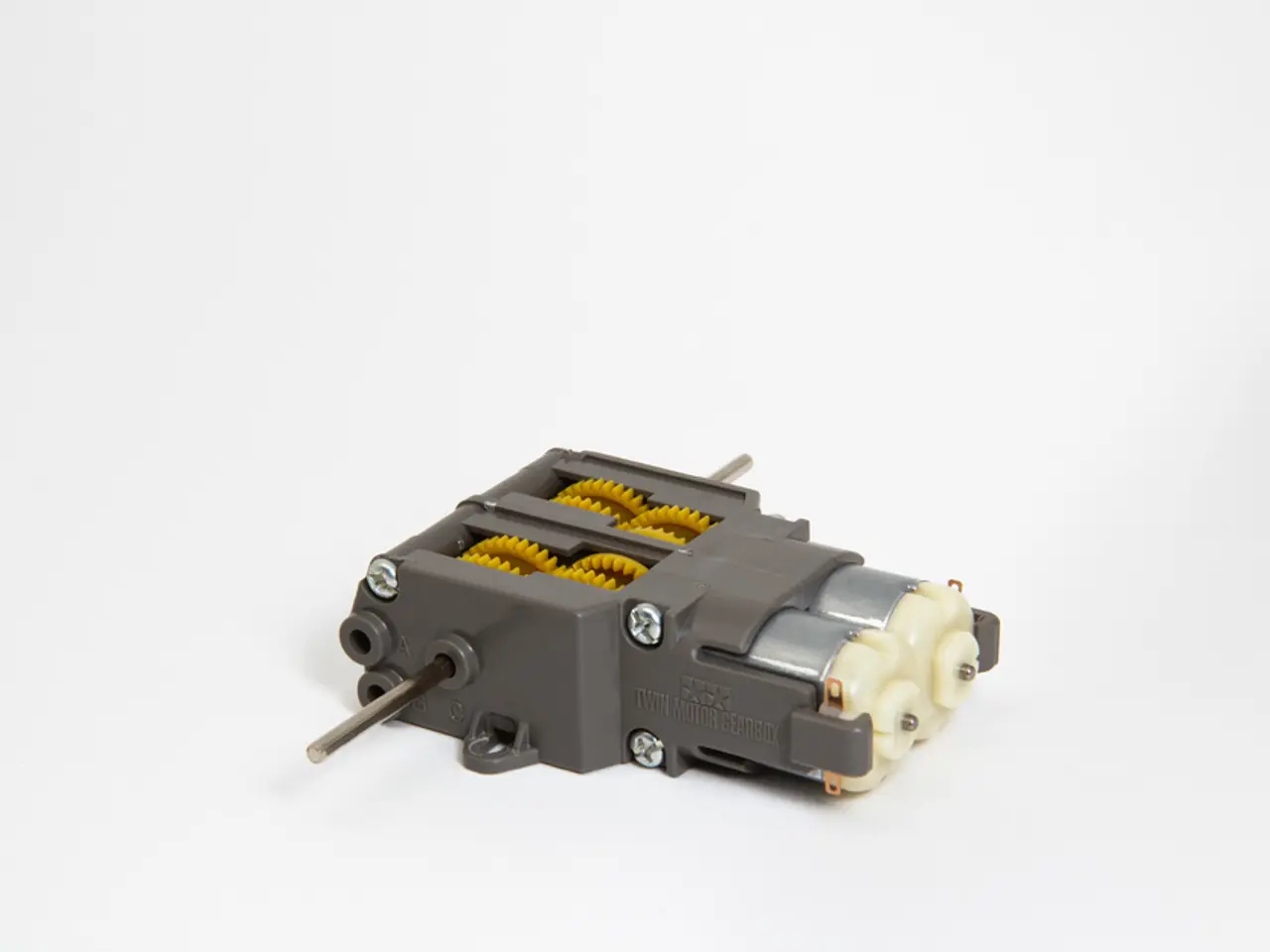
Transformation of Energy Through Motor Developments: An Examination of Motor Technology's Growth and Possibilities
Welcome to our exploration of electric motors! These marvels of technology are at the heart of sustainable and profitable ventures in green manufacturing and transportation. Today, we delve into the fascinating journey of electric motors, from their early foundations to their modern-day innovations.
Early Foundations in Electricity and Magnetism (17th-18th centuries)
Our story begins with the scientific understanding of electricity, tracing back to ancient observations of static electricity. In the 1600s, William Gilbert coined the term "electric," studying magnetism and electricity. Fast forward to 1799, Alessandro Volta invented the voltaic pile, the first true battery producing continuous electric current, enabling sustained electrical experiments.
Discovery of Electromagnetism (1820s)
In 1820, Hans Christian Oersted discovered that electric currents create magnetic fields, linking electricity and magnetism. André-Marie Ampère developed the mathematical foundation of electromagnetism shortly after. These breakthroughs were essential for creating devices converting electrical energy into mechanical motion.
First Electric Motors (1820s-1830s)
Michael Faraday, a British scientist, invented the first electric motor in 1821, demonstrating continuous rotational motion from electric current. Around the same period, Ányos Jedlik built a rudimentary functional electric motor, powering a small model car the next year. Thomas Davenport in America built a primitive electric motor-powered locomotive in 1835.
Advancements and Patents (1880s-1890s)
Nikola Tesla's designs and patents, including the AC induction motor in 1883-1887, revolutionized electric motors by using alternating current for efficient power transmission and scalable motor design. Tesla's patents were licensed by George Westinghouse, fostering the development of AC power systems, which became dominant over the earlier DC systems.
Electric Motors in Automobiles
Between the 1880s and early 1900s, electric motors integrated directly into wheels (wheel hub motors) drove the early electric vehicle boom. Ferdinand Porsche developed and raced cars fitted with electric wheel hub motors in 1897 and presented electric motor cars at the 1900 Paris Exhibition.
In summary, the evolution of the electric motor was a cumulative process starting from the discovery of electricity and magnetism, through the invention of the first motors by Faraday and others, to Tesla’s groundbreaking AC motor designs that enabled the practical and commercial use of electric motors in industry and transport by the late 19th and early 20th centuries.
Our post includes a FAQ section, informative tables, diagrams, lists, and statistics to enhance understanding and make the post visually appealing. We also provide real-world case studies to offer tangible examples of possibilities and innovations. Stay tuned for more insights into the key aspects of motor technology and its environmental impacts!
Science and technology played significant roles in the development of electric motors. Michael Faraday's invention of the first electric motor in 1821 marked the beginning of continuous rotational motion from electric current, while Nikola Tesla's AC induction motor designs in the 1880s revolutionized electric motors, enabling scalable motor design and practical use in industry and transportation.




