
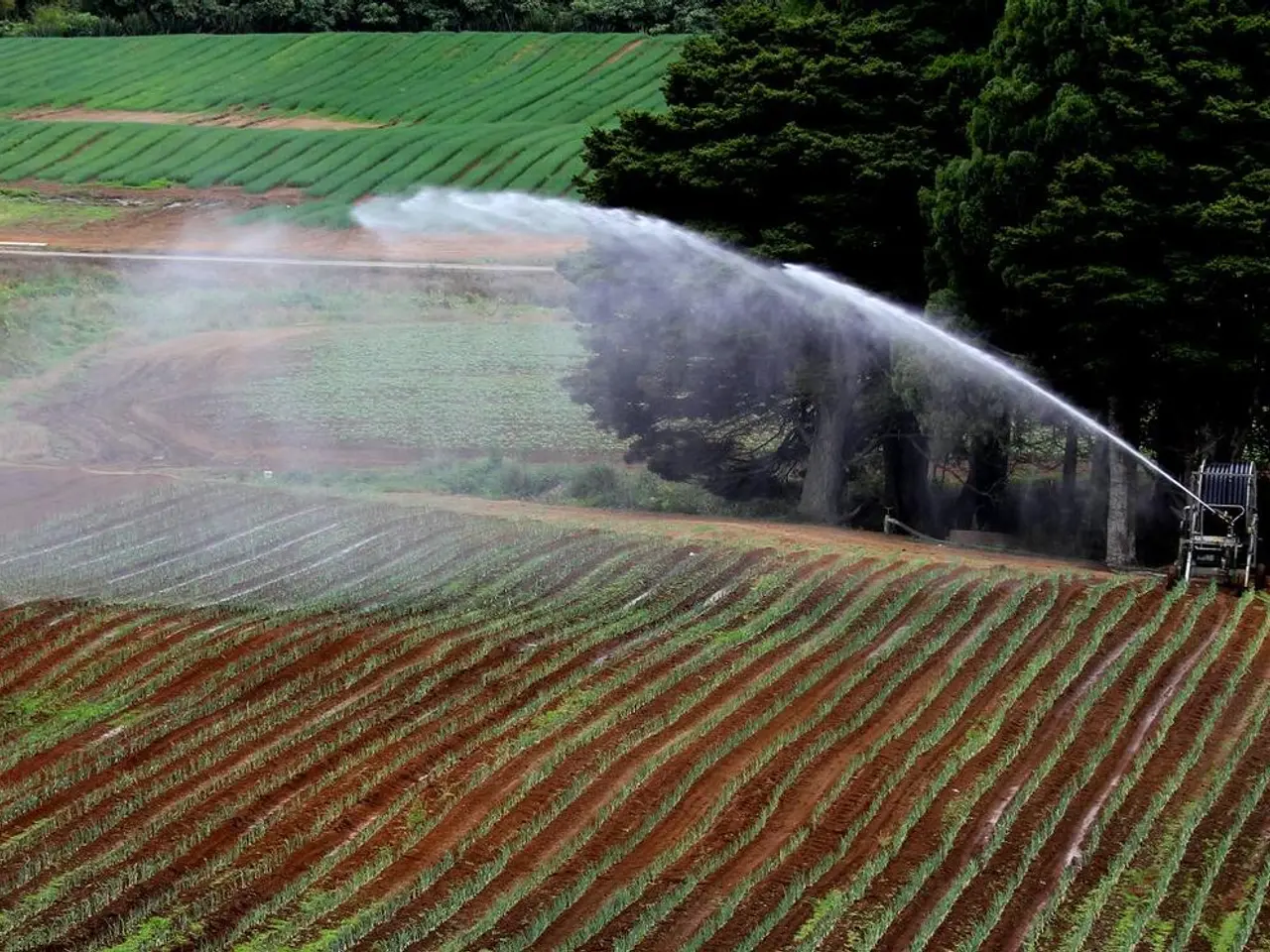
Technological Advancements Shaping the Agricultural Landscape!
In the heart of 2024, the farming industry is experiencing a remarkable transformation, propelled by the integration of cutting-edge technologies. Key among these are artificial intelligence (AI) and machine learning, Internet of Things (IoT) sensors, autonomous machinery, blockchain for supply chain transparency, and advanced data analytics.
Artificial Intelligence and Machine Learning are playing a significant role in farming decision-making. AI platforms, powered by large datasets from satellite imagery, drones, soil sensors, and weather data, offer precise recommendations for irrigation, fertilization, pest control, and crop rotation. These advanced systems can forecast pest infestations, disease outbreaks, and weather hazards, enabling proactive management and reducing chemical inputs [1][2][4]. Companies like BASF and Yara International are leading the charge in AI-driven crop optimization [5].
The Internet of Things (IoT) is revolutionizing farming by providing real-time data on crucial factors such as weather conditions, crop health, soil moisture, and farming machinery performance. Soil sensors, for instance, measure moisture, temperature, and nutrient levels, enabling farmers to apply the right amounts of water and fertilizers, thus conserving resources and preventing runoff [1][2].
Autonomous machinery and robotics are automating labor-intensive tasks with high precision, reducing waste and reliance on diesel machinery. Self-driving tractors, robotic planters, irrigation systems, and drone sprayers are becoming commonplace, freeing up time for farmers [1][2][5]. XAG, for example, released an automated drone with seeding and pesticide spraying features in 2024 [1][2][5].
Blockchain technology is enhancing traceability and transparency in the agricultural supply chain, recording each step from farm to consumer. This technology meets growing demands for food provenance and supports sustainable practices [1][2].
Data Integration and Decision Support Platforms are combining satellite data, sensor data, weather forecasts, and AI to offer comprehensive tools for crop monitoring, yield optimization, and collaboration among farmers and advisors [3][5].
Additional emerging trends include biotechnology for sustainable crop protection and vertical farming systems, but the above technologies dominate the current innovation landscape [3][5]. Together, these advances are driving a transition towards more efficient, sustainable, and resilient farming operations worldwide.
Other notable advancements include the use of lime for soil stabilization in construction and agriculture, and Grundfos pumps as pivotal tools in transforming agricultural irrigation. These developments underscore the ongoing evolution of the farming industry, as it embraces technology to overcome challenges and meet the growing demands of a global population.
References:
[1] Farming Today, BBC Radio 4, 2024. [2] The Future of Farming: AI, IoT, and Automation, Forbes, 2024. [3] The Role of Biotechnology in Sustainable Agriculture, Nature, 2024. [4] AI and Machine Learning in Agriculture: A Review, Journal of Agricultural Science, 2024. [5] The Impact of Technological Innovations on the Agricultural Industry, The Economist, 2024.
AI technology is aiding in efficient farming decision-making with AI platforms offering recommendations for irrigation, fertilization, and pest control, utilizing data from satellites, drones, sensors, and weather forecasts.
With the help of IoT sensors, farming is becoming more data-driven, allowing farmers to monitor weather conditions, crop health, soil moisture, and machinery performance in real-time, enabling proactive management and resource conservation.




