
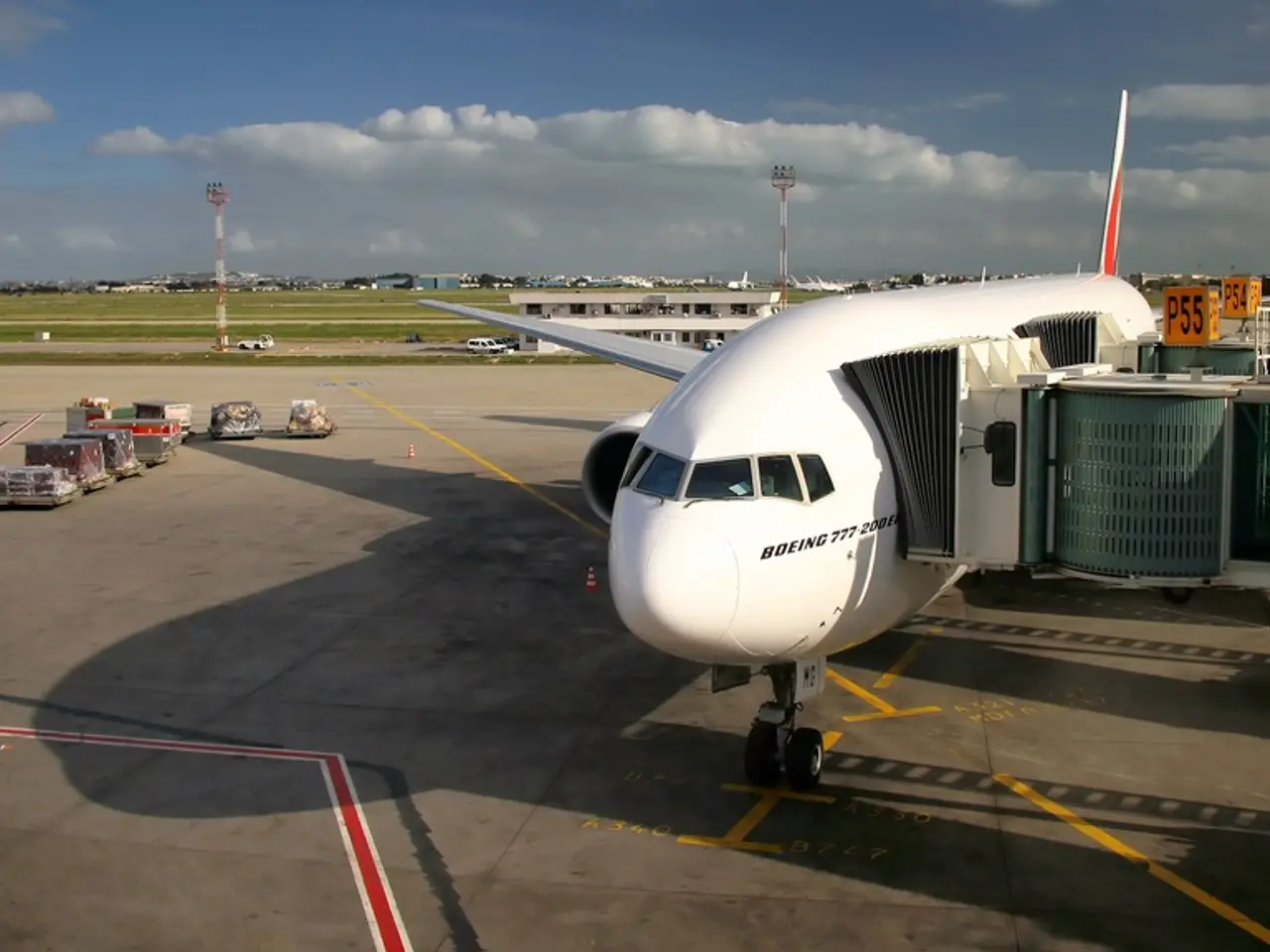
Lufthansa's Sharkskin Aircraft Coating - Emulating Nature's Efficiency
Lufthansa, in partnership with chemical giant BASF, is set to implement the AeroSHARK coating on its 10-aircraft Boeing 777F fleet, a move that is expected to bring significant fuel savings and contribute to the airline's goal of achieving carbon-neutral flights by 2050.
The AeroSHARK coating is designed to reduce drag on aircraft surfaces, thereby improving fuel efficiency and reducing carbon emissions. This technology has already been adopted by EVA Air for its Boeing 777F fleet, indicating its effectiveness in achieving fuel savings.
Trials of AeroSHARK were launched towards the end of 2019, with a Boeing 747-type aircraft being covered with approximately 500 m² of the special material. After 1,500 flight hours of observation, the product was found to be efficient for use on cargo planes.
The German company BASF will produce the coating materials, which are designed to be resistant to high UV radiation, temperature, and pressure changes at high altitudes. The materials are also intended to be easy to apply.
The purpose of applying AeroSHARK is to reduce friction on the fuselage of the aircraft during flight, thereby saving fuel. It is estimated that a reduction of more than 1% in friction can be achieved with AeroSHARK.
Since the exact expected savings for Lufthansa’s 10 Boeing 777F freighters are not yet stated, this detail currently remains unavailable from the given sources. However, it is estimated that the fleet could save 3,700 tons of fuel with AeroSHARK. This equates to the fuel consumption of 48 cargo flights between Frankfurt and Shanghai.
Moreover, the application of AeroSHARK is expected to result in a decrease of 11,700 tons of CO emissions per year. This reduction in emissions is a significant step towards Lufthansa's goal of achieving carbon-neutral flights by 2050.
It is planned to cover all cargo aircraft in the Lufthansa fleet with AeroSHARK from the beginning of 2022. The development of AeroSHARK is an ongoing joint project between Lufthansa Technik and BASF, and it is clear that this technology is set to play a crucial role in Lufthansa's future flight operations.
- The implementation of AeroSHARK coating on Lufthansa's 10-aircraft Boeing 777F fleet is a step towards the airline's goal of achieving carbon-neutral flights by 2050, as it falls under the umbrella of environmental-science, aiming to reduce carbon emissions and improve fuel efficiency.
- The partnership between Lufthansa and BASF, a chemical giant, is not limited to the production of AeroSHARK coating materials, as the technology has financial implications due to the potential fuel savings and energy reductions it offers to the airline industry.
- The application of AeroSHARK technology is not merely a passive response to climate-change concerns, but an active step that leverages advancements in technology to improve the environmental footprint of the aviation industry, thereby contributing to a more sustainable future.




