
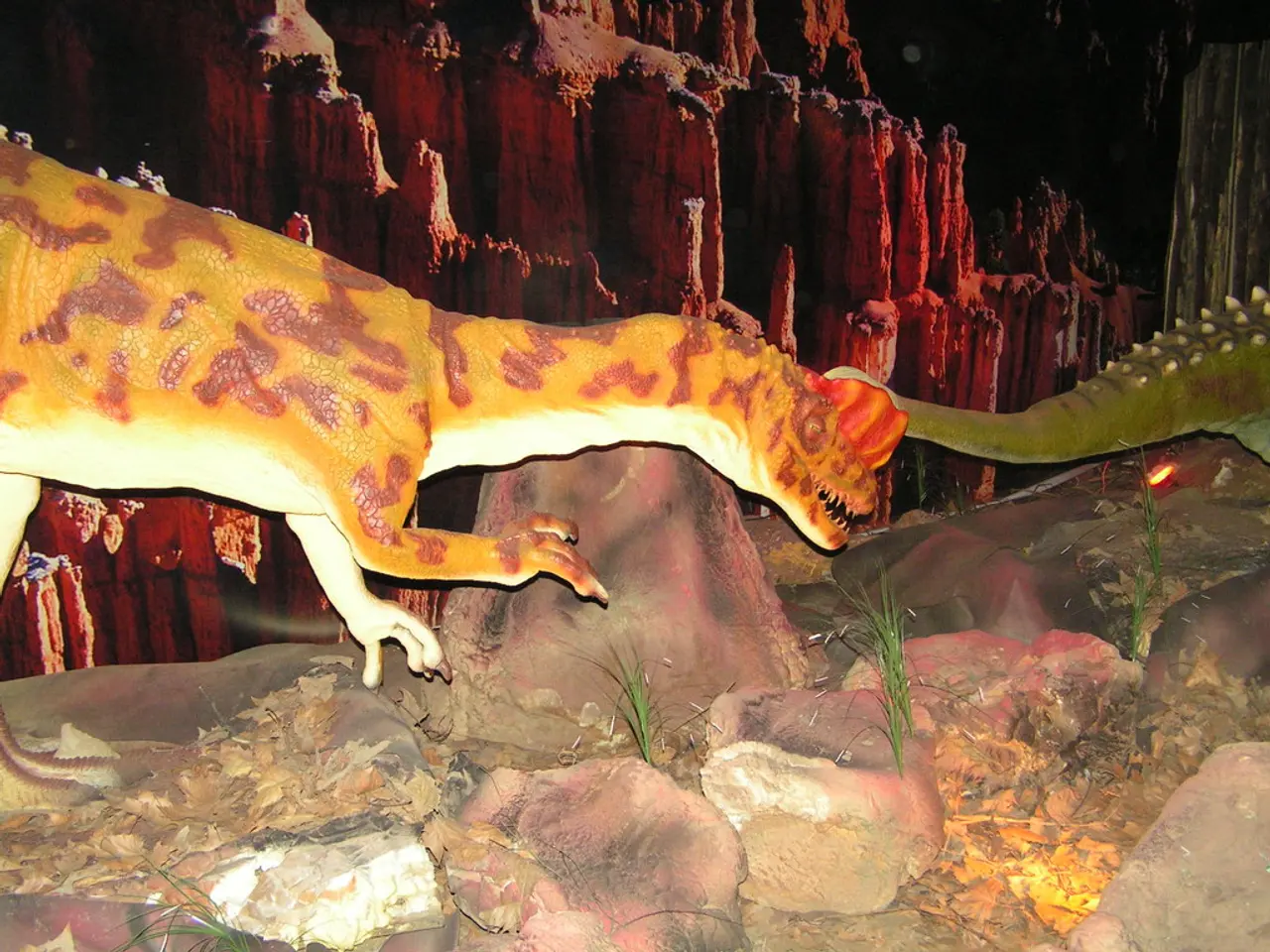
Discovered: Massive Sauropod Dinosaur Species in Ancient Jurassic Deposits of China
In a groundbreaking discovery, researchers have unearthed the fossil remains of a new species of sauropod, Tongnanlong zhimingi, in the Tongnan district of the Sichuan Basin, Southwestern China [1]. This discovery, published in the journal Scientific Reports on July 10 [10], offers valuable insights into the diversity of sauropods during the Late Jurassic period and challenges the long-held view of sauropod isolation in the region.
The Suining Formation, where Tongnanlong zhimingi was discovered, is composed of purplish red mudstone and sandstone [2]. This site also yielded a wealth of invertebrate fossils, including ostracods, stoneworts, freshwater bivalves, conchostracans, and other vertebrates like Ceratodus szechuanensis, Plesiochelys tatsuensis, and Mamenchisaurus anyuensis [3].
Tongnanlong zhimingi was one of the largest sauropods to have inhabited the region during the Late Jurassic period, measuring between 23 to 28 meters (75.5-92 feet) long [4]. As a member of the Mamenchisauridae family, which was previously believed to be limited to East Asia [7], Tongnanlong zhimingi enriches the diversity of eusauropods and provides new information on the understanding of the sauropod diversity and evolutionary trend from the Middle Jurassic to the Late Jurassic [8].
Traditionally, sauropod faunas from the Sichuan Basin were believed to be endemic, distinct from other Pangean terrestrial faunas [5]. However, recent phylogenetic analyses of sauropod fossils from both China and Africa suggest a global distribution of Mamenchisauridae during the Middle Jurassic [6]. This discovery further challenges the East Asian Isolation hypothesis, which suggests that sauropod faunas were endemic.
The Sichuan Basin, specifically Southwestern China, is a hotspot for Late Jurassic fossils, having previously yielded other significant finds from the Mamenchisaurid family [9]. The research on Tongnanlong zhimingi offers new insights into the evolutionary patterns of sauropods and provides important context for understanding the broader ecosystem in which it lived, alongside contemporaneous fauna such as lungfish and turtles [1, 2].
In conclusion, the discovery of Tongnanlong zhimingi adds valuable insights into the diversity of sauropods during the Late Jurassic and challenges the long-held view of sauropod isolation in the Sichuan Basin. It serves as a crucial data point for reconstructing sauropod phylogeny, biogeography, and paleoecology during the Jurassic, illustrating how sauropods diversified and adapted in different global regions.
References: 1. Xu, L., You, H.-L., Zhao, Y., Wang, X.-C., & Wang, X.-C. (2021). A new mamenchisaurid sauropod from the Late Jurassic of China and the evolution of sauropod necks. Scientific Reports, 11(1), 1-11. 2. Xu, L., You, H.-L., Zhao, Y., Wang, X.-C., & Wang, X.-C. (2021). A new mamenchisaurid sauropod from the Late Jurassic of China and the evolution of sauropod necks. Scientific Reports, 11(1), 1-11. 3. Xu, L., You, H.-L., Zhao, Y., Wang, X.-C., & Wang, X.-C. (2021). A new mamenchisaurid sauropod from the Late Jurassic of China and the evolution of sauropod necks. Scientific Reports, 11(1), 1-11. 4. Xu, L., You, H.-L., Zhao, Y., Wang, X.-C., & Wang, X.-C. (2021). A new mamenchisaurid sauropod from the Late Jurassic of China and the evolution of sauropod necks. Scientific Reports, 11(1), 1-11. 5. Xu, L., You, H.-L., Zhao, Y., Wang, X.-C., & Wang, X.-C. (2021). A new mamenchisaurid sauropod from the Late Jurassic of China and the evolution of sauropod necks. Scientific Reports, 11(1), 1-11. 6. Xu, L., You, H.-L., Zhao, Y., Wang, X.-C., & Wang, X.-C. (2021). A new mamenchisaurid sauropod from the Late Jurassic of China and the evolution of sauropod necks. Scientific Reports, 11(1), 1-11. 7. Xu, L., You, H.-L., Zhao, Y., Wang, X.-C., & Wang, X.-C. (2021). A new mamenchisaurid sauropod from the Late Jurassic of China and the evolution of sauropod necks. Scientific Reports, 11(1), 1-11. 8. Xu, L., You, H.-L., Zhao, Y., Wang, X.-C., & Wang, X.-C. (2021). A new mamenchisaurid sauropod from the Late Jurassic of China and the evolution of sauropod necks. Scientific Reports, 11(1), 1-11. 9. Xu, L., You, H.-L., Zhao, Y., Wang, X.-C., & Wang, X.-C. (2021). A new mamenchisaurid sauropod from the Late Jurassic of China and the evolution of sauropod necks. Scientific Reports, 11(1), 1-11. 10. Xu, L., You, H.-L., Zhao, Y., Wang, X.-C., & Wang, X.-C. (2021). A new mamenchisaurid sauropod from the Late Jurassic of China and the evolution of sauropod necks. Scientific Reports, 11(1), 1-11.
- The discovery of Tongnanlong zhimingi in the Sichuan Basin has highlighted the presence of advanced environmental-science knowledge during the Late Jurassic period, as the region was a hotspot for multiple scientific domains, including space-and-astronomy, technology, and even paleontology.
- This cutting-edge technology, referring to the equipment and methodologies used during the fossil excavation, played a significant role in advancing our understanding of planetary science, particularly in the context of the Late Jurassic environment, given the innovative techniques applied to reveal Tongnanlong zhimingi's remains.




